There are many ways of taking plant medicine. Different forms work better for different herbs and some forms work better for certain people than others. Here is an overview of some different methods of preparing herbs as medicine.
Teas
There are mainly two different ways to make herbal tea: infusions and decoctions.
Infusions
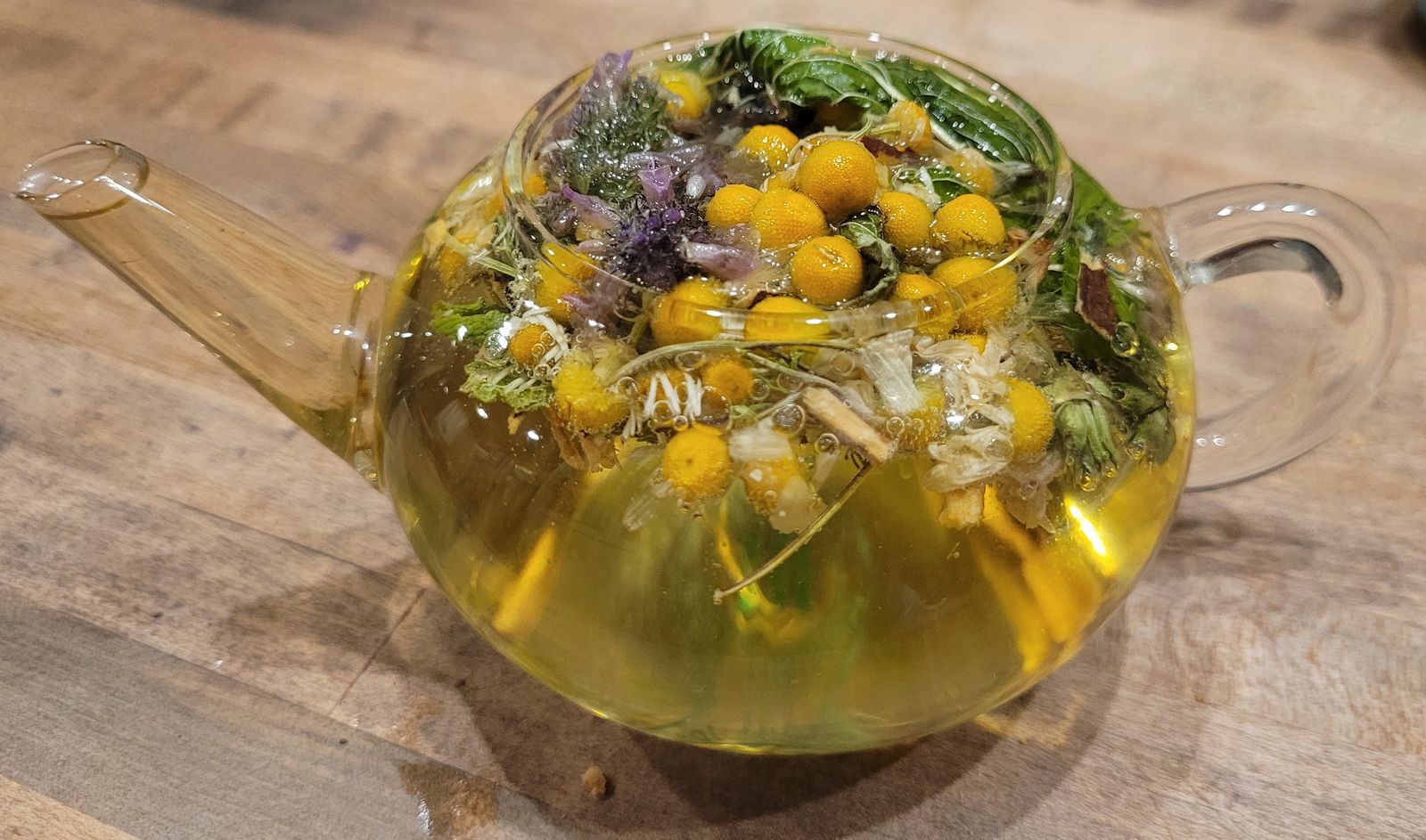
An infusion is where you take the herb and pour water over it. The infusion method is best for herbs, flowers, leaves and the aerial — above ground — parts of the plant.
You can pour boiling water over the plant and cover it with a lid; you can pour room temperature water over the plant and let it sit overnight; or you can make sun tea, where you put the plant in a clear jar with water and let it sit in the sun for a few hours, up to a day.
Usually the longer you let it steep, the better and more potent the medicine will be.
Decoctions
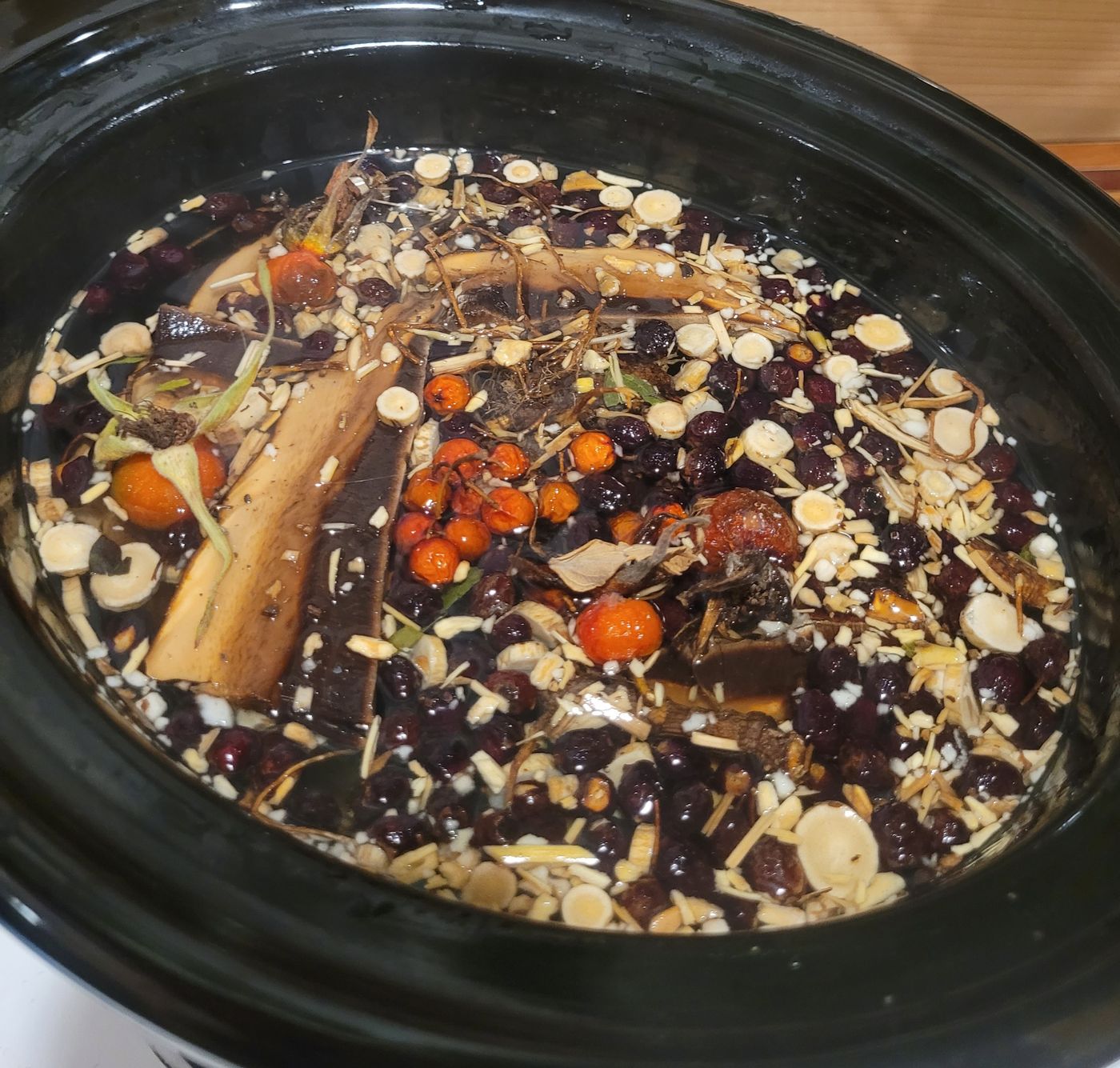
Decoctions are where you actively boil the plant in water for a longer period of time, usually at least ten minutes. The decoction method is preferable for roots, bark, and more woody parts of plants.
It’s important to cover the pot while you are boiling the herbs, especially with aromatic plants or plants with volatile oils, because the oils rise with the steam and having a lid allows them to drip back down into the medicine. The same goes for infusions.
Another method of decoction is using a crock pot — you can put the herbs in on low heat and let them cook for days to make an extra strong decoction. You can also make extra strong decoctions by boiling the plant down for a long time and letting the water reduce to a more concentrated brew.
Tinctures
Tinctures are where a plant is soaked in alcohol for a period of time, usually four to six weeks. The alcohol extracts the medicinal properties of the plant and infuses them into the liquid.
After the maceration period you strain out the plant material and put the tincture in a dark bottle, and it’s ready to use. The reason to use a dark bottle is that light breaks down the medicine over time, so keeping it somewhere dark makes it last longer.
Tinctures are taken in varying doses depending on the plant and the practitioner. A few specific plants can be harmful to take in large doses, so usually those plants are taken in doses of a few drops. Oftentimes the dosage of a tincture will be 30 drops or one dropperful — although some practitioners prefer to use only a few drops even with gentle plants, as their effects can be felt even when used in this subtle way.
Tinctures are great for aromatic herbs and herbs with volatile oils, as the alcohol extracts these properties very well. Depending on the plant you will use different percentages of alcohol to extract its medicine, as different constituents and alkaloids extract at different alcohol percentages.
Tinctures are great for herbs you need to take often, and for combinations of herbs as a formula. They work very well for physical healing as well as for working with plants on an emotional and spiritual level.
Flower Essences
Flower essences are often used to connect with plants on a more subtle energetic level, for emotional and spiritual healing.
They are made by picking a fresh flower or herb and soaking it in water in a glass bowl in the sunlight, putting intention into the medicine for healing. After this you mix in just a tiny bit of brandy to preserve the medicine. This method imprints the energetic frequency of the plant into the liquid and supports us in our spiritual evolution.
Usually when one takes flower essences they meditate on the frequency of the plant and allow it to gently penetrate their energetic body, which brings about emotional and spiritual healing. Oftentimes one will work with a flower essence from a few weeks to a month, to allow the plant to fully penetrate in a way that brings about the change they are seeking.
Herbal Steams
Herbal steams are used for a variety of ailments — from issues with the respiratory system to pains in the physical body and musculoskeletal system, as well as being used for the female reproductive system.
With herbal steams you often make a decoction and then wrap yourself in a blanket and hover over the pot of steaming liquid, allowing the steam to penetrate your body. This method is often used in respiratory conditions, where you cover your head with a blanket and breathe in the steam to loosen phlegm and clear up the sinuses and respiratory tract.
When used on other parts of the body you make a big pot and put a stool or seat over it, then wrap your whole body with a blanket and allow the steam to penetrate through your skin. This helps with aches and pains, releasing tension, and with the intake of medicine.
A traditional women’s medicine is yoni steams, where a woman sits over the pot in a seat with a hole in it and allows the steam to rise into her yoni. This can help with infections, menstrual cramps, and many other issues in the female reproductive system.
Herbal Baths
Many of us know about epsom salt baths, but herbal baths are also a great way to release tension and allow medicine to literally soak into us. In many Asian cultures they do herbal baths, as in traditional bath houses. This allows the herbs to penetrate into our body on a deeper level and supports many different ailments.
Herbal baths can help with physical aches and pains, menstrual issues, respiratory infections, digestive issues, fever, and so much more. An example is mugwort baths — mugwort is a traditional herb used for the digestive system, the female reproductive system and the nervous system, as well as for energetic clearing and dream work. It is a highly aromatic plant, very medicinal and cleansing.
There are also traditions of floral baths, specifically in indigenous cultures, where the fresh plant is mashed up or left to soak in water for a number of hours or a day, then poured over the head and body and allowed to air dry rather than be dried with a towel. These floral baths are used for spiritual protection and energetic support, as well as support in physical ailments and emotional healing.
Herbal Infused Oils
Infused herbal oils are made either by soaking a plant in oil at room temperature or in a warm dark place for a number of months, or by cooking them at very low heat in a double boiler or crock pot.
Infused herbal oils can be used for pain relief, skin issues, deeper internal wounds, massage, aromatherapy and much more. They can also be added to baths for deeper penetration.
A common use of herbal oils is making them into salves or pomades by mixing the oils with beeswax to create more of a cream-like texture, so it can be applied to wounds and sit on the skin in a stickier form — holding in moisture and not dispersing as quickly.
In the tradition of Ayurveda it is common to do herbal body oiling for constitutional balance, where you cover your whole body in oil daily to bring about balance in the way your body interacts with various elemental forces and your environment.
Essential Oils
Essential oils are most commonly used for aromatherapy — putting them in a diffuser or bath, or mixing them with a carrier oil and placing them on the skin. It is highly beneficial to place them on the soles of the feet to absorb their potent medicinal properties.
They are often used for nervous system relaxation and aid in sleep, placed on pillows or worn on the body. They are also commonly used for their antibacterial, antifungal and antimicrobial properties, as well as for boosting the immune system.
Some common ones used in this way are tea tree and cedar oil, or thieves blend — a mixture of cinnamon, clove, lemon or orange, eucalyptus and rosemary. During the black plague, people who were scavenging used thieves blend to boost their immunity so they would not become ill.
Essential oils are a highly valuable remedy because of how potent they are. Pounds and pounds of plant material are used to make a tiny bottle, and they truly are the essence of the plant in a way. There is some controversy surrounding their sustainability, but regardless they are a well loved and widely used remedy.
Cautions. It is important not to place essential oils directly on your skin, because they are very potent and can burn you. Within this, it is also important that if you place them in a bath you mix them with a carrier oil first.
There is large controversy in the herbal world about the use of essential oils internally. Some people claim to find benefit in ingesting them, while others consider them too harsh for ingestion and damaging to the GI tract and internal organs. I would recommend that people do not ingest essential oils, as they are too concentrated and can be damaging.
Herbal Juices
Traditionally in the Amazon, as well as in other cultures, herbs are prepared like a juice — where leaves are pounded and squeezed, or bark is soaked in water as a cold maceration and then strained out.
This form of taking plant medicine is generally used for traditional Shipibo plant dietas, as well as for cleanses, and overall it is a very potent and fresh way to take in the whole plant in its essence. Plant juice is fresh and truly contains the spirit as well as the medicinal essence of the plant, as it is extracted when the plant is closest to its physically living form.
Plant juices can be used for cleanses, tonics, and nourishing formulas to support the overall vitality of the person. Dosage varies with the specific plant used and the intended purpose.
In Conclusion
Regardless of how we take in our plant medicine, all are great and generally very accessible ways to work with herbs and medicinal plants.
Different remedies lend themselves to different preparations, as the chemical constituents, oils and other compounds are better extracted in unique ways. Some aspects of a plant will lend better to certain preparations for its unique medicinal properties, while another aspect of the plant will lend better to a different preparation.
It is important to look into what remedy you are using and how to prepare it, to get the best outcome and potency of its medicine for your specific needs. I hope this simple guide has been helpful in your understanding of some different ways to prepare medicinal plants.
For specific guidance on what form of medicine to take, what plants, and what dosage, please consult your healthcare provider.